
The evolution & future of parking security
Advancements in technology and artificial intelligence (AI) is revolutionising many industries, and parking security is just one of these.
Historically, car parks have relied on traditional measures such as CCTV, barriers, security patrols, lighting and access controls to help protect people and their vehicles. While these systems remain important, technology such as AI, smart sensors and automation are creating new opportunities that make parking environments more secure, efficient and responsive than ever before.
The future of parking security isn't just about adding more cameras or barriers – it's about building intelligent systems that can identify potential risks, respond to incidents and provide valuable information in real time.
So, what could the next generation of parking security look like?
AI-powered surveillance
Artificial intelligence is already transforming how security systems analyse information.
Traditional CCTV systems record what happens in a car park, but generally someone must be present to monitor the footage or review it afterwards. However, AI-powered video analytics can take a more proactive approach by analysing activity automatically, detecting events that may require attention and predicting potential security threats.
For example, AI-enabled systems can potentially detect:
- Unusual movement or activity
- Vehicles entering restricted areas
- People in areas of prohibited access
- Vehicles travelling in the wrong direction
- Suspicious or abandoned objects
- Unusual patterns of behaviour
- Incidents occurring outside normal operating conditions
As a result, an operator will no longer be required to continuously watch the footage as intelligent systems can highlight potentially significant events and generate alerts – this helps security teams focus their attention on other priorities.
Smarter sensors
The future of parking security isn't just about cameras – smart sensors can provide another layer of information across a car park.
Sensors can monitor factors such as vehicle presence, occupancy, movement and access. When connected to a wider parking management system, this information can provide a much clearer picture of what is happening throughout a site.
For example, sensors could help identify when:
- A vehicle has remained in an unusual location for an extended period
- A restricted space has been occupied
- A particular area is experiencing unexpected activity
- A parking facility is becoming congested
- Equipment or infrastructure requires attention
By continuously collecting information, smart sensors can help turn a car park from a passive environment into a connected and responsive one.

Automation & incidence response
One of the biggest advantages of connected parking technology is the ability to automate certain responses.
If a security system detects an event, it may be able to trigger a predefined action – this eliminates the need to wait someone to intervene manually, thus improving efficiency.
Dependent upon the system and specific circumstances, this could include sending an alert to a security team, displaying a warning message, controlling access to a particular area or directing operators towards relevant camera footage.
Automation doesn't necessarily mean removing people from the security process. Instead, it supports security teams by reducing repetitive tasks and helping them respond more quickly to events that require human judgement and resource.
Connected access control
Access control is another area where technology is developing rapidly.
Traditional barriers and access systems can already regulate who enters and leaves a car park. Increasingly, however, parking systems can combine access control with technologies such as automatic number plate recognition (ANPR), digital permits, mobile applications and cloud-based management platforms.
This creates a plethora of opportunities for more flexible and intelligent access management.
For example, a system could recognise an authorised vehicle, check its access permissions and manage entry without requiring the driver to use a physical ticket or speak to an operator.
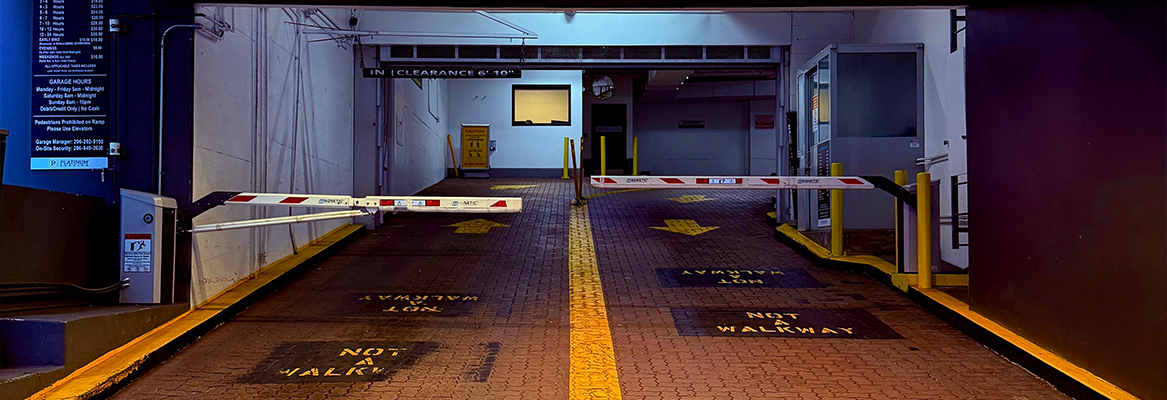
Cloud technology & remote monitoring
Another important development is the move towards connected, cloud-based parking systems.
Instead of security information being confined solely to equipment on-site, authorised personnel can potentially access relevant information remotely through connected platforms.
This can make it easier to manage multiple car parks, monitor equipment and respond to alerts across different locations.
Implementing centralised management in this way can provide a more consistent approach to security while reducing the need for every site to be monitored independently.
Predictive security
One of the most interesting developments is the potential for parking security to become increasingly predictive.
Rather than simply responding when something goes wrong, intelligent systems can analyse patterns and identify situations that may require attention.
For instance, if a system detects repeated unusual activity in a particular part of a car park, operators may be able to investigate the area and take preventative action before a crime can occur.
Similarly, data from sensors, cameras and access systems could help identify recurring problems, allowing parking operators to review lighting, access arrangements, patrols or other security measures.
Ultimately, the goal is to shift from reactive security to proactive security.
Technology still needs people
Despite the rapid development of AI and automation, technology isn't a replacement for good security management.
AI systems can analyse huge amounts of information quickly, but human oversight remains critical. Security professionals provide context, make decisions and respond to situations that technology alone may not understand.
That’s why the strongest parking security strategies are likely to combine technology with people. CCTV, AI analytics, sensors, access control and automation can provide information and alerts, while trained personnel can assess situations and take the appropriate action.
Privacy & responsible technology
As parking technology becomes more sophisticated and elaborate, privacy and responsible use will also become increasingly important.
Systems that use cameras, ANPR, AI and connected data need to be implemented carefully, with appropriate consideration given to data protection, transparency, security and access controls.
For parking operators, choosing reputable technology providers and establishing clear policies around how data is collected, stored and used will be crucial in future-proofing their security strategy.
What does the future car park look like?
The car park of the future is likely to be considerably more connected than today's facilities.
Behind the scenes, connected systems could monitor equipment, manage access, identify emerging problems and provide operators with valuable data about how the facility is being used.
This doesn't mean every car park will look like a futuristic technology hub – in fact, the most effective innovations will work quietly in the background.
The result should be a parking environment that’s not only easier to manage, but also more responsive and better equipped to deal with security challenges.
How to prepare for the future of parking security
AI, smart sensors and automation are changing the possibilities for parking security, but adopting new technology should be part of a wider security strategy.
For parking operators, the key questions you should be asking are:
- What are the biggest security risks at our site?
- Where could technology improve our existing processes?
- How can different security systems work together?
- How will incidents be monitored and managed?
- How will personal data be protected?
- What role will trained security personnel continue to play?
Connected technology, intelligent monitoring and human expertise will all work in unison in the car park of the future. This will deliver safer and more responsive places for everyone who uses them.
Conclusion
Parking security is moving beyond standalone cameras, barriers and patrols, towards integrated systems that can see more, understand more and respond faster.
For organisations looking to improve the security of their parking facilities, now is the time to consider how emerging technology can complement existing measures.
At Safer Parking, effective parking security starts with understanding the risks, the environment and the people who use it. Technology may continue to evolve, but the objective remains the same – creating safer, more secure parking environments to prevent crime and the fear of crime.
Safer Parking accreditation is awarded to parking facilities that have met the requirements of a risk assessment conducted by the Police. These requirements mean the parking operator has put in place measures that help to deter criminal activity and anti-social behaviour, thus fostering a safer parking environment.
Get in contact with the team today to discuss accreditation and reinforce the security and reputation of your car park.