
Creating parking environments where women feel safe & confident
Public parking facilities provide essential access to work, shopping, leisure activities and public services. For many users, particularly women and girls, the decision to use a car park depends not only on convenience and location but also on whether the environment feels secure, comfortable and welcoming.
As national efforts to tackle violence against women and girls (VAWG) continue, there is growing recognition that the design, management and maintenance of public spaces influence both security and perceptions of personal safety. Car parks are an important part of that wider public realm and often form the first and last stage of a journey.
The Safer Parking initiative, delivered by Police Crime Prevention Initiatives (Police CPI), is a UK-wide, police-supported standard for parking facilities. Accreditation is awarded to facilities that meet the requirements of a police risk assessment and have measures in place to deter crime and anti-social behaviour, protect people and vehicles, as well as reduce the fear of crime.
The core Safer Parking award assesses how parking facilities are designed, managed and maintained to reduce crime and anti-social behaviour and improve public confidence. It considers the user journey through features such as lighting, surveillance, access control, signage, pedestrian routes, customer assistance and incident-response procedures.
Related awards include Safer Parking Freight for lorry parks and truck stops, Safer Parking Accessible for accessible and inclusive parking facilities, and Safer Parking Accessible Electric Vehicle (EV) for sites with accessible charging facilities. The accessibility awards are jointly owned by Police CPI and Disabled Motoring UK.
Together, the awards apply consistent principles while recognising the needs of different facilities and users.
Understanding what makes people feel vulnerable
Research consistently shows that women are more likely than men to report concerns about personal safety when travelling alone, particularly during hours of darkness and in unfamiliar locations. While crime statistics provide an important measure of risk, people often form impressions of a place based on environmental cues and their personal experience of it.
Factors that commonly contribute to feelings of vulnerability include:
- Poor or inconsistent lighting
- Hidden corners and restricted sightlines
- Isolated pedestrian routes
- Poorly maintained stairwells and lifts
- Graffiti, litter and signs of neglect
- Overgrown landscaping that obstructs visibility
- Confusing wayfinding and signage
- Limited staff presence
- Restricted access to assistance or emergency support
- Faulty or poorly maintained equipment, including video surveillance systems (VSS), help points and payment machines
These features can influence perceptions regardless of recorded crime levels. Neglect suggests weak oversight, while a clean, well-maintained facility signals active management and care.

Crime & the fear of crime
Parking design must address both recorded crime and the fear of crime.
A location may have relatively little recorded crime yet still feel intimidating, whereas an easy-to-navigate, well-managed and thoughtfully designed environment can reduce opportunities for offending as well as providing reassurance.
Successful parking facilities therefore seek to:
- Reduce opportunities for crime and anti-social behaviour
- Address environmental factors that contribute to anxiety and perceptions of vulnerability
Crime prevention through good design
A key strength of Safer Parking is its alignment with Secured by Design (SBD), the official police security initiative owned by UK policing.
Secured by Design promotes crime-prevention measures and products that have achieved its Police Preferred Specification. These products are tested to relevant security standards and certified by an independent third-party certification body accredited by the United Kingdom Accreditation Service (UKAS). Independent certification includes initial testing, regular retesting and inspections of manufacturing facilities to support continuing quality.
When appropriately specified, installed and maintained, these products and services can help support crime prevention objectives by:
- Improving physical security
- Increasing resilience against criminal attack
- Reducing opportunities for theft, vandalism and anti-social behaviour
- Enhancing protection for customers and staff
- Supporting long-term operational resilience
- Demonstrating a commitment to public safety
For parking operators, integrating Secured by Design principles provides an evidence-based approach that complements the wider requirements of the Safer Parking initiative and supports continual improvement.
Designing facilities that inspire confidence
The design of a parking facility has a direct influence on how people experience and use the space. Well-considered design can improve usability, enhance perceptions of security, and discourage criminal behaviour.
Lighting
Consistent, well-designed lighting remains one of the most important features within any parking environment. Effective illumination improves visibility, supports natural surveillance, assists VSS performance, and helps eliminate poorly lit areas that may cause unease.
Visibility & sightlines
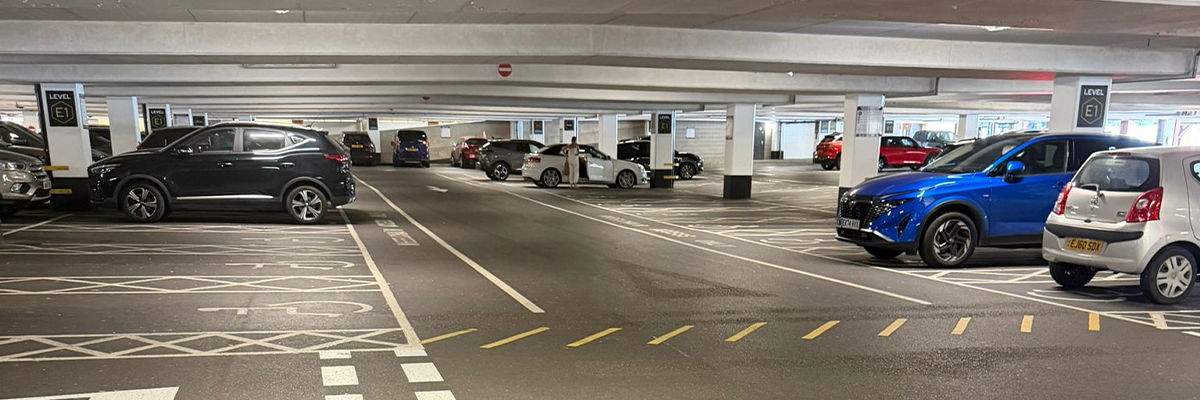
People feel more confident when they can clearly see and understand their surroundings. Open layouts, good sightlines, and reduced opportunities for concealment support natural surveillance and improve the overall user experience.
Pedestrian routes
Pedestrian routes should be direct, intuitive and clearly visible. The wider, cumulative journey should also be considered, recognising that a person’s sense of safety can be affected by any stage of their journey, not just their time within the car park. People should not be required to walk through isolated areas or navigate unnecessarily complex layouts to reach their destination, and routes should allow users to change direction if they feel uncomfortable.
Stairwells, lifts & enclosed areas
Enclosed spaces often generate particular concerns. Stairwells and lifts should be highly visible, well illuminated, properly maintained, and supported by appropriate surveillance measures where necessary.
Help points & customer facilities
Help points, payment machines and customer-assistance facilities should be located prominently so that users can obtain support quickly and confidently when required.
Wayfinding
Clear signage and intuitive navigation reduce uncertainty and help people move efficiently throughout a facility, particularly when visiting an unfamiliar location.
Making VSS truly effective
VSS is the broader, modern term for video surveillance and includes CCTV. It also covers technologies such as ANPR, body-worn video and other digital surveillance systems.
VSS is often viewed as the hallmark of a secure parking facility. However, cameras alone do not create reassurance or prevent incidents.
To deliver meaningful benefits, VSS should form part of a wider security strategy that incorporates:
- Appropriate positioning and coverage
- Image quality suitable for evidential purposes
- Effective monitoring and management arrangements
- Routine inspection and maintenance
- Clearly defined incident response procedures
- Communication to users regarding available assistance
Integrated with these arrangements, VSS can support proactive oversight and timely incident response.
The value of good management
Effective day-to-day management maintains standards and reassures visitors that faults, damage and security concerns will be addressed promptly.
Examples of good practice include:
- Routine inspections
- Prompt repairs to faults and damage
- Rapid removal of graffiti and litter
- Maintenance of lighting and VSS
- Responsive customer support
- Regular reviews of security concerns
- Visible staff presence where operationally appropriate
Where should an existing car park operator start?
For an operator reviewing an existing car park, the best starting point is to understand how the whole journey works in practice rather than beginning with a single product or capital project. This means combining incident and maintenance records with an on-site assessment and the lived experience of users, then prioritising actions according to risk, reassurance, cost and deliverability.
1. Establish a baseline: Review reported incidents, complaints, near misses, call-out records, maintenance faults and patterns of use by time and location. Map entrances, exits, payment points, lifts, stairs, pedestrian routes, help points and links to surrounding streets or transport stops
2. Walk the site as a user: Inspect it in daylight and after dark, at busy and quiet times. Test lighting consistency, sightlines, wayfinding, accessibility, VSS coverage, help-point operation, mobile reception, cleanliness and the visibility of staff or assistance. Include the approach to and departure from the car park, not only the parking bays
3. Consult women and girls early: Use facilitated safety walks, short surveys, customer feedback, local community groups and discussions with staff to identify where people feel exposed, watched, trapped, confused or unable to obtain help. Seek views from women and girls with different ages, disabilities, travel patterns and caring responsibilities. Engagement should be accessible, appropriately safeguarded and offered at different times so that it does not capture only the most confident or frequent users
4. Use the VAWG Environmental Audit: The SBD Preventing Violence Against Women and Girls Through Environmental Design guide includes a VAWG environmental audit and risk assessment at Appendix A. This provides a useful framework to support the assessment of a site
5. Act on immediate weaknesses: Repair defective lights, cameras, doors, lifts, help points and payment machines; remove graffiti and litter; cut back vegetation; improve temporary signage; and address locations where routes are obstructed or assistance is unclear. These visible improvements can strengthen confidence while larger works are planned
6. Prioritise longer-term changes: Develop a costed plan for issues such as redesigning pedestrian routes, opening sightlines, relocating payment or assistance points, improving lighting or surveillance, strengthening access control and increasing staff presence. Assign owners, deadlines and measures of success. Where significant redesign or refurbishment is planned, operators should consider early engagement with their local police Designing Out Crime Officer (DOCO)
7. Report back and review: Tell users what was heard, what will change and why some proposals may take longer. Revisit the site with women and girls after improvements and monitor incidents, faults, complaints and user confidence. Consultation should be an ongoing part of management, not a one-off exercise only used to validate decisions already made
Consultation is essential because a technically compliant feature may still fail to reassure the people expected to use it. Women and girls can identify avoidance behaviours, points of uncertainty and perceived escape or concealment risks that may not appear in crime data or a daytime inspection. Treating that evidence alongside professional risk assessment helps operators improve both safety and the feeling of safety, target investment more effectively and demonstrate that concerns have led to visible action.
Listening to women & girls
Although well-designed car parks benefit everyone, women and girls may have particular concerns when travelling alone, after dark or through unfamiliar environments. Operators should therefore seek and incorporate their views when assessing facilities, planning refurbishments or designing new developments.
Government and city-level research support this participatory approach. Department for Transport research published in 2024, focused on transport safety in England, highlights significant underreporting of VAWG on the transport system, uncertainty about reporting procedures and the need for measures that reflect varied experiences.
Its supplementary studies examine the experiences of disabled women and school-aged girls. London’s public-space safety guidance likewise emphasises meaningful participation and an intersectional approach to planning and design. In practice, operators should conduct safety walks and engagement at different times of day, establish clear and trusted routes to assistance and reporting, and consider journeys to and from the car park as well as movement within it. They should assess user concerns alongside incident data, explain how feedback has informed design, management, staff training and maintenance, and evaluate whether interventions improve both actual safety and user confidence. No single measure will meet the needs of every woman or girl.
Consultation can also reveal concerns that crime statistics, technical audits and operational inspections may overlook, including:
- Areas with limited opportunities to attract attention
- Limited visible management presence
- Locations where escape routes appear constrained
Accessibility & inclusive design
Measures that improve confidence among women and girls include good lighting, accessible routes, effective wayfinding, visible assistance points and unobstructed pedestrian paths. These features can also support disabled users, older people and others who may feel vulnerable when travelling independently.
Where facilities include public EV charging, operators should consider PAS 1899:2022, the British Standards Institution specification for accessible public charge points, which provides requirements and recommendations covering charge point design, placement, the surrounding physical environment and information provision. Charging points should also be located with personal safety in mind, in well-lit areas where users can see and be seen, with VSS coverage where this is considered necessary. PAS 1899:2022 should be applied alongside wider accessibility, safety and security guidance.

The benefits of Safer Parking accreditation
Safer Parking accreditation translates these principles into a nationally recognised, police-supported standard and a structured framework for continual improvement.
Benefits include:
- Independent recognition of good practice
- Increased public confidence
- Enhanced reputation and trust
- Clear benchmarks for monitoring performance and directing future investment
- Support for wider community safety objectives
- Demonstrable commitment to crime prevention and public safety
Importantly, meaningful improvements do not always require significant capital investment. Relatively straightforward measures, such as improving lighting, strengthening maintenance regimes, enhancing operational procedures, and adopting Secured by Design principles, can positively influence both security and user confidence.
Conclusion
Efforts to tackle violence against women and girls make it clear that safer public spaces depend on more than recorded crime alone. People must also feel respected, reassured and able to travel with confidence.
Because car parks often shape the beginning and end of a journey, their design and operation can influence how people experience a destination and whether they choose to return.
The Police Service’s Safer Parking initiative gives operators a practical framework for improving both the reality and perception of security. By combining police-backed standards with effective management, inclusive design, robust maintenance and meaningful engagement with women and girls, operators can reduce opportunities for crime and create parking environments in which all users feel welcome, secure and confident.
If you’re interested in obtaining Safer Parking accreditation for your car park, you can contact the team here.