
EV charging bays & security risks: what car park operators need to know
It’s likely you’ve noticed electric vehicles (EVs) become an increasingly common sight on UK roads, which also brings a higher demand for convenient charging solutions
For car park operators, installing an EV charger can make a site more attractive to customers, increase dwell time and help future-proof the car park – but EV charging bays also introduce some additional security considerations.
Operators must think beyond simply installing an electric vehicle EV charger, as poorly positioned charging points, vulnerable cables and inadequate lighting can all contribute to a hazardous environment. A well-designed EV car park should be safe, secure and easy for drivers to use at any time of day.
Keep reading to learn what car park operators should consider when introducing EV chargers to their facility.
Why security matters at EV charging bays
Unlike a standard parking space, an EV charging bay requires drivers to interact with electrical equipment and, in many cases, spend more time at the location whilst their vehicle charges.
However, this can create several potential security and safety considerations.
Drivers may be searching for EV chargers late at night or during quieter periods, meaning a charging bay could be used when there aren’t many people around. Customers may also leave their vehicle unattended while charging, highlighting the importance of good site security.
Government guidance on EV chargepoint design specifically recommends illuminating chargepoints and the surrounding area to help users feel safe at night.
For operators, this means EV charging should be considered as part of the wider car park security strategy, rather than treated as a standalone installation.
Location is one of the biggest security considerations
The positioning of EV bays can have a significant impact on how safe and secure they feel.
Ideally, charging bays should be located in areas that are:
• Well lit – enough to illuminate the charging equipment and surrounding pedestrian routes
• Visible from occupied areas, buildings or staffed facilities where possible
• Covered by existing CCTV
• Easy for vehicles and pedestrians to access
• Clearly signposted so drivers can find and navigate to them with ease
Location is particularly important for larger or multi-storey car parks, where some levels or sections may be considerably quieter than others.
An operator may be tempted to place EV chargers in an unused corner because it makes installation easier. But a location that is convenient isn't necessarily the best location from a security perspective.
The ideal approach is to consider security, accessibility, lighting and visibility on a holistic level at the planning stage.
CCTV help protect both customers & equipment
CCTV is already an important component of many modern car parking security strategies. EV charging bays provide another reason to ensure cameras are positioned effectively.
A camera covering an EV charging area can help deter criminal behaviour and provide valuable evidence if an incident occurs.
Cameras should provide a clear view of:
• The EV charging equipment
• Vehicles using the bays
• The surrounding pedestrian areas
• Entrances and exits
• Payment or access-control equipment
• Routes between the charging bays and the rest of the car park
It's also important to take lighting into account when reviewing CCTV coverage. A camera can technically cover an EV bay, but if there is poor illumination, this can render the recorded footage useless.
Recent accessibility guidance for EV charging locations recommends security cameras around chargepoints coupled with sufficient lighting, allowing cameras to capture the area effectively.
For operators, this reinforces the principle of CCTV and lighting working in unison.
Charging cables shouldn’t be an oversight
Charging cables are an important part of the security picture.
Tethered cables can potentially create trip hazards, become damaged through use or be vulnerable to vandalism. Government design guidance recommends appropriate cable management and notes that cable protection can help to reduce vandalism.
Operators should therefore consider:
• How cables are stored when not in use
• Whether cables can be kept clear of pedestrian routes
• Protection against accidental vehicle damage
• Whether charging equipment is suitably robust for the environment
• How damaged equipment will be identified and repaired
• Whether the installation has appropriate electrical containment and cable protection
UK government specifications for commercial and residential car park charging infrastructure also require dedicated, safe and unobstructed routes for electrical cabling. This should include suitable containment systems such as ducting, trunking, conduits, trays or ladders.
Good cable management isn't just about appearance; it also contributes to user safety and equipment security.
Lighting is essential for a secure EV car park
Lighting significantly influences how safe a car park feels.
This is particularly relevant to EV drivers, because charging may take place outside normal daytime hours – meaning they need to connect their vehicle and potentially make a payment when it’s dark.
Poorly lit equipment or pedestrian routes can therefore make the experience uncomfortable or worrisome and may discourage customers from returning.
When assessing lighting, operators should look beyond the parking space itself. Consider the entire customer journey, from entering the car park to exiting – all the touchpoints that motorists encounter should be appropriately illuminated.

Government guidance recommends illuminating the chargepoint and surrounding area, while accessibility guidance also highlights the importance of lighting routes from charging points to nearby amenities.
Consider the wider customer journey
Security isn't only about preventing theft or vandalism – it’s also about making customers feel comfortable using the facility.
Someone searching online for an EV recharge station or car park near me will expect the location to provide more than just a space to leave their vehicle.
They may want to know:
• Is the car park open when I need it?
• Are the EV chargers easy to find?
• Is the area well lit?
• Can I see where I'm going?
• Is there CCTV?
• Is there staff or assistance available?
• Can I pay easily?
• What happens if the charger doesn't work?
These factors can influence the customer experience and the reputation of the car park.
As for public chargepoints, the Public Charge Point Regulations 2023 place requirements on chargepoint operators covering areas including payment, pricing information, reliability and customer support.
For ease of mind, drivers should choose Safer Parking accredited car parks – these facilities have met the requirements of a risk assessment conducted by the Police, reinforcing that they have extensive measures in place to ensure the safety of people as well as their vehicles.
If you’re interested in obtaining Safer Parking accreditation for your car park, you can contact the team.
Think about charger & network security
Physical security isn't the only consideration.
Modern EV chargers can be connected devices, meaning operators should also consider the security of the technology behind the charging service. Depending on the equipment and operating model, this could include the chargepoint's communications, payment systems, software, network connections and access controls.
UK regulations for smart chargepoints include security requirements aligned with the ETSI EN 303 645 cyber security standard.
Car park operators should therefore understand:
• Who is responsible for the charger?
• Who manages its software and connectivity?
• How are faults reported?
• Who receives security alerts?
• How quickly can a compromised or faulty unit be taken out of service?
• What customer data is being processed?
• What happens if the charging network goes offline?
Secured by Design’s Secure Connected Device (SCD) scheme is the UK’s police-backed accreditation for IoT products, which assesses the product against all 13 provisions of the ETSI standard – a requirement that goes beyond government legislation. Choosing products that have achieved SCD accreditation therefore gives you confidence that the product is as resistant to cyber attacks as possible.
Fire safety should form part of the overall risk assessment
Security isn't the only consideration when introducing EV charging.
For covered car parks in particular, operators should consider fire safety when installing or retrofitting EV chargepoints to their facility.
The UK government has published specific guidance for covered car parks – it addresses considerations when parking or charging EVs and when installing chargepoints in covered car parks.
This means that EV charging projects should be assessed as part of the car park's wider safety strategy, rather than as an isolated upgrade.
Prevent misuse of EV bays
Another practical issue is the misuse of charging bays. An EV charging space can become unavailable if a vehicle parks there without charging, reducing the number of drivers who can actually use the available infrastructure.
Government statistics guidance recognises this issue, noting that the availability of charging can be reduced when vehicles occupy designated charging spaces without actively using the charger.
By implementing clear signs, appropriate parking terms and effective enforcement, operators can help keep charging bays available for their intended purpose.
The security checklist for EV charging bays
Before installing EV chargers, car park operators should review the following elements to ensure maximum safety.
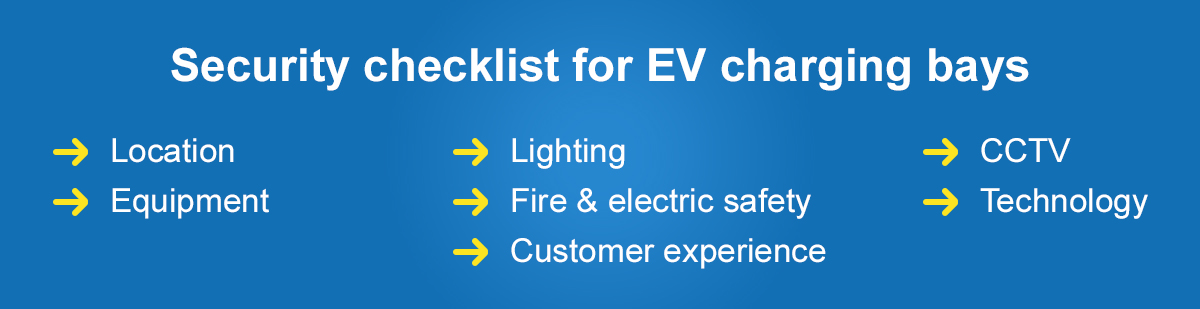
Location
• Are the bays visible and overlooked?
• Can customers reach them safely?
Lighting
• Is the charging equipment well illuminated?
• Are pedestrian routes sufficiently lit?
• Does the lighting support CCTV coverage?
CCTV
• Are the bays clearly visible on camera?
• Are entrances, exits and pedestrian routes covered?
• Is footage managed properly?
Equipment
• Are charging cables protected and properly managed?
• Can equipment endure the expected level of use?
• Is there a clear maintenance / fault-reporting process?
Technology
• Who’s responsible for the chargepoint network?
• Are the appropriate cyber security measures in place?
• How are faults and security incidents handled?
Fire & electrical safety
• Has the installation been assessed against relevant standards and guidance?
• Are electrical cables appropriately protected?
Customer experience
• Can drivers easily locate the charging bays?
• Is signage clear?
• Can customers get help if an EV charger isn't working?
• Are the bays accessible and safe to use?
After ensuring your car park fulfils all the above criteria, you may also consider obtaining Safer Parking Accessible EV accreditation, the UK-wide police standard for car parks. This award conveys to your customers that their parking accessibility and EV charging needs will be met upon arrival, giving them confidence for their journey.
You can contact the team here to learn more.
Conclusion
The transition to electric vehicles is transforming customers’ expectations. As more drivers search for EV chargers, the quality and security of the charging experience will become an important part of choosing where to park.
For car park operators, ensure to plan the charger as well as the environment around it.
Good lighting, visible CCTV, robust equipment, effective maintenance and thoughtful site design can all help create a safer and more reassuring experience for EV drivers.
Safer Parking accreditation is awarded to car parks who have implemented the necessary measures to ensure the safety and security of people and their vehicles. As well as signalling to customers that you take their safety seriously, it also positions your parking facility competitively against rivals.
Reach out to the Safer Parking team to start your accreditation journey today.